powered
by FreeFind
Updated May 14, 2014
Home
page
Bio and
contact info
Media
reports that resulted from our efforts
The Sidebar
(Peter's blog)
Got a tip?
My father's relationship with narco doctors: Gerson Carr, Ryan
Krebs, and Milton Uhley
by Peter M. Heimlich
(Peter Heimlich) has
spent years trying to debunk the ideas
promoted by his father and his colleagues,
whom the son’s website describes as a
“motley crew of hacks, quacks and
narco-doctors.” from This one will
leave you all choked up by John
Kominicki, Long Island Business News, May 10,
2011
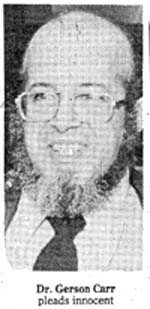
Gerson
Carr MD, PhD
Through
the 1980s, Dr. Gerson C. Carr was the so-called "Research
Director" at the Heimlich Institute, then
located on the campus of Cincinnati's Xavier
University. In the early 1970s, Carr had been a
surgical resident under my father at Jewish Hospital
in Cincinnati. Upon completion of his training,
Carr practiced medicine in the state of New
Mexico.
Carr's career as a
physician came to an abrupt end in 1979, when he was
convicted of 42 counts of illegally obtaining and
supplying narcotics to patients. Several of his
patients died of overdoses.
The case was
covered extensively in the Albuquerque press.
According to press reports, two years prior to his
conviction, Carr had been investigated by the New
Mexico Board of Medical Examiners when one of his
patients, a 20-year-old female and known heroin
addict, died of an overdose of Dilaudid while in his
care. Carr had previously been warned by the Board not
to prescribe for this patient. According to an article
in the Albuquerque Journal, a search warrant affidavit
stated that two more of Carr's patients died of
overdoses while in his care.
A lengthy article in July
12, 1979 Albuquerque Observer, Verdict Finds Carr
Guilty, describes the testimony of the boyfriend of
Mary Gennari, an addict patient of the future Heimlich
Institute "Research Director":
He said the second time he saw Dr. Carr leading Mary,
who looked very dazed, to the bed and then commencing
sexual relations with her.
According
to a 1978
published statement, Carr was unrepentant
and portrayed himself as a victim of the Drug
Enforcement Agency and "Big Brother bureaucracy."
According to another news report, Carr's attorney
claimed that Carr was "acting from a sickness" and
should receive psychiatric care. In 1979, Carr was
tried, convicted, and sentenced to a one-to-five year
sentence and his medical license was revoked.
None
of this deterred my father from hiring Carr. On the
contrary, the New Mexico Department of Corrections
stated that Carr served nine months at the Las Lunas
Correctional Facility from October 13, 1981-June 18,
1982, at which time he was paroled to Cincinnati. My
father assisted with Carr's legal representation and
hired him to run the Heimlich Institute, then located
at Xavier. At the time, my brother Phil Heimlich told
me he helped with Carr's parole.
Xavier's
human resources department has no record of Carr's
employment, therefore he was probably hired and paid
in-house by the Heimlich Institute. Facts suggest
Xavier administration was never made aware of the
facts in Carr's criminal background. (Neither was I.
At the time, my father told me that Carr had been in
jail because of "financial problems." Thirty years
later, my research into my father's career turned up
the information here.)
Carr held the job for almost a
decade, during which time he functioned as my father's
right-hand man and co-authored
several journal articles with him. Carr also
worked on other Heimlich projects, such as the
Heimlich Micro-Trach, an oxygen-delivery device. Carr
also researched "malariotherapy," the claim my father
has been promoting since the early 1980s, that people
can be cured of cancer, Lyme Disease, and AIDS by
infecting them with malaria.
Now in Cleveland, Dr.
Carr and his tenure at the Heimlich Institute was
featured in Tom Franscis's August 11, 2004 Cleveland
Scene cover story, Heimlich's Maneuver:
It wasn't a strenuous job, he confesses. "We had a lot
of very long conversations, and the bottom line is, we
never really did anything scientific together."
...Heimlich was impressed by Carr's rhetorical flair.
"He comes up with some things that are so off the
wall, like 'Let's cure people of cancer by giving them
malaria,'" says Carr. "You research it a little bit,
but [Heimlich] liked me because I could make it sound
logical."
In 1990, after 10 years at the Heimlich Institute,
Carr was fired, a fate he accepted obediently. "There
were some personal and family and sexual problems,"
says Carr, "and I was involved with that. I was
guilty."
Dr.
Carr died May 12, 2010.
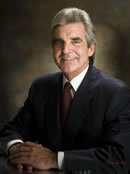
Ryan
Krebs MD, JD
Carr wasn't the only
doctor who trafficked in narcotics who was offered a
top position at the Heimlich Institute at Xavier. In
1983, a year after Carr was installed there, my father
testified as a character and alibi witness for a close
friend of my brother Phil, Ryan A. Krebs MD, who was
being tried in Federal Court in a high-profile,
multi-state, narcotics conspiracy trial. The scheme
involved setting up inner-city clinics engaging in
mass prescription-writing for addicts.
Click
here for some selected Detroit Free Press
articles which describe the incredibly sordid
operation, Krebs's role, and a couple articles about
my father's courtroom testimony.
From an
October 29, 1982 report:
A
famous chest surgeon testified Wednesday that Dr.
Ryan Krebs, charged with conspiring with Nellie Bell
Kassim to operate a multimillion-dollar drug ring,
was a "marvelous young man" who he would still
welcome to accept a prestigious research post. Dr.
Henry Heimlich, inventor of the Heimlich maneuver
credited with saving the lives of many choking
victims, testified in federal court Thursday that
Krebs, 29, is "like my son - he's absolutely honest,
and I can't conceive of him straying...I can't
accept any of the things that I've heard charged
against him."
...Heimlich,
62, said he first met Krebs 10 years ago through
Heimlich's son (Phil), who was a classmate of Krebs'
at Stanford University. Heimlich said he'd followed
Krebs' education and "was impressed with his
intelligence and decency." Heimlich said Krebs
visited the Heimlich family in Cincinnati between
Dec. 11 and 13, 1981. Kassim had testified earlier
that she had seen Krebs writing prescriptions for
her in Detroit that weekend.
Heimlich
said during that weekend he offered Krebs a job as
associate director of the Heimlich Institute at
Xavier University, "where he would have directed
research and medical work."
According to the
testimony, Krebs even had a standing job offer working
for my father:
I spoke to my son (Phil) or asked him to get in touch
with Ryan and asked Dr. Krebs to come and head the
direction of the - to act as Associate Director, and
head the direction and running of the research and
medical work at the Heimlick (sic) Institute...I would
say that he would be welcome to work at the Heimlick
Institute at any time he should so desire.
According to a Novermber
23, 1982 Free Press report, drug ring organizer Nellie
Bell Kassim did not share my father's opinion:
(She) depicted Krebs as an initially naive young
intern who, once he learned the scope of the drug
operation, wanted to be part of it and "make a million
dollars" as fast as possible.
Interestingly, in
almost 100 pages of testimony, my father
neglected to mention that at the time, a convicted
ex-physician narcotics trafficker, Gerson Carr, was
"Research Director" at the Heimlich Institute.
Presumably that fact would have interested the court.
Krebs
was convicted
and sentenced to a five-year term in federal prison
and his
medical license was revoked by the Michigan state
medical board. Since 1994, Krebs has
been a
practicing attorney in Texas and advertises
himself as a medical doctor. He was a guest
at my brother Phil's 2001 wedding.
Why would my father
provide such ardent testimony on behalf of my
brother's best friend? And what was Phil doing in the
early 1980s while Krebs was dealing drugs? For some
reason, those years are missing from his resume:
Phil graduated with distinction from Stanford
University in 1975 and received his law degree from
the University of Virginia Law School in 1979. Phil
served as Assistant Hamilton County Prosecutor from
1984-1993.
According
to this
November 15, 2003 article in the Topeka (KS) Courier-Journal
about my brother's appearance at a local "Mayor's
Prayer Luncheon":
Heimlich's search
culminated in 1981 at a Bob's Big Boy restaurant in
Michigan, where he said he asked God to forgive him
for his mistakes and accepted Christ as his savior.
Click
here for an audio in which Phil describes in
detail his religious epiphany in a hamburger
restaurant. He says this was in the Detroit suburb of
Grosse Point. He says he was in Michigan for a court
case, one that supposedly involved a woman he was
living with. Phil doesn't say if he took the
opportunity to check in with Dr. Krebs who at the time
was either working at the drug mill or under arrest.
The late Milton H. Uhley
MD of Beverly Hills was a longtime colleague and
personal friend of my father. Dr. Uhley co-authored
two papers on the Heimlich maneuver, one with my
father and Dr. Edward A. Patrick (The Heimlich Maneuver:
Best technique for saving any choking victim's
life, Postgraduate Medicine, May 1990) and The Heimlich Maneuver
in Clinical Symposia (1979), a non-peer reviewed
magazine published by CIBA Pharmaceuticals.
Dr. Uhley was also a "Dr.
Feelgood" to the stars, prescribing for the likes of
Marilyn Monroe, at whose home Uhley made
after-midnight housecalls to "sedate her," according
to this book.
A July
21, 1995 California Medical Board complaint against
Dr. Uhley describes allegations including gross
negligence for excessive narcotics prescribing
(including 1890 Percocets for one patient),
prescribing to addicts, repeated negligent acts,
incompetence, and other charges. He surrendered his
California medical license on September 26th, 1996.
Here are both documents:
Uhley's
April 5, 2000 obituary in Variety, the show business
trade paper, neglects to include those facts, but
instead diplomatically states:
Uhley's patients from 1948 through 1995 included many
people in the entertainment, art, architecture and
business communities.
Despite
his qualifications for the job, I don't know if my
father ever offered Dr. Uhley a job at the Heimlich
Institute.
Copyright Peter
Heimlich @all rights reserved; click
here to report broken links or to
contact the author.
Gerson
Carr, Ryan Krebs, Milton Uhley, narcotics,
prescription, presecriptions, dilaudid,
percoset, medical boards, license, Heimlich,
maneuver, Phil Heimlich, Henry Heimlich,
Gerson Carr, Ryan Krebs, Milton Uhley,
narcotics, prescription, presecriptions,
dilaudid, percoset, medical boards, license,
Heimlich, maneuver, Phil Heimlich, Henry
Heimlich, Gerson Carr, Ryan Krebs, Milton
Uhley, narcotics, prescription,
presecriptions, dilaudid, percoset, medical
boards, license, Heimlich, maneuver, Phil
Heimlich, Henry Heimlich, Gerson Carr, Ryan
Krebs, Milton Uhley, narcotics, prescription,
presecriptions, dilaudid, percoset, medical
boards, license, Heimlich, maneuver, Phil
Heimlich, Henry Heimlich, Gerson Carr, Ryan
Krebs, Milton Uhley, narcotics, prescription,
presecriptions, dilaudid, percoset, medical
boards, license, Heimlich, maneuver, Phil
Heimlich, Henry Heimlich, Gerson Carr, Ryan
Krebs, Milton Uhley, narcotics, prescription,
presecr
Gerson
Carr, Ryan Krebs, Milton Uhley, narcotics,
prescription, presecriptions, dilaudid,
percoset, medical boards, license, Heimlich,
maneuver, Phil Heimlich, Henry Heimlich,
Gerson Carr, Ryan Krebs, Milton Uhley,
narcotics, prescription, presecriptions,
dilaudid, percoset, medical boards, license,
Heimlich, maneuver, Phil Heimlich, Henry
Heimlich, Gerson Carr, Ryan Krebs, Milton
Uhley, narcotics, prescription,
presecriptions, dilaudid, percoset, medical
boards, license, Heimlich, maneuver, Phil
Heimlich, Henry Heimlich, Gerson Carr, Ryan
Krebs, Milton Uhley, narcotics, prescription,
presecriptions, dilaudid, percoset, medical
boards, license, Heimlich, maneuver, Phil
Heimlich, Henry Heimlich, Gerson Carr, Ryan
Krebs, Milton Uhley, narcotics, prescription,
presecriptions, dilaudid, percoset, medical
boards, license, Heimlich, maneuver, Phil
Heimlich, Henry Heimlich, Gerson Carr, Ryan
Krebs, Milton Uhley, narcotics, prescription,
presecriptions, dilaudid, percoset, medical
boards, license, Heimlich, maneuver, Phil
Heimlich, Henry Heimlich, Gerson Carr, Ryan
Krebs, Milton Uhley, narcotics, prescription,
presecriptions, dilaudid, percoset, medical
boards, license, Heimlich, maneuver, Phil
Heimlich, Henry Heimlich, Gerson Carr, Ryan
Krebs, Milton Uhley, narcotics, prescription,
presecriptions, dilaudid, percoset, medical
boards, license, Heimlich, maneuver, Phil
Heimlich, Henry Heimlich